
Your Wikipedia article does more than describe your brand. It can help position your company within the trust layer that search engines and answer engines use when deciding what to surface, cite, and connect.
For brands seeking visibility in both traditional search and AI-generated answers, the question is no longer just, “Can we rank?” It is also, “Is our brand credible enough to be referenced by the systems that shape discovery?”
Successful Wikipedia page creation can help establish that credibility by documenting the brand in a neutral, encyclopedia-style format that makes it easier for search engines, AI systems, journalists, researchers, and users to understand and recognize the entity.
Why Wikipedia matters for authority
Wikipedia is the most visible reference point on the web. When a brand has a properly supported article, it signals that there is enough independent coverage for the brand to be documented in an encyclopedia-style format, which is materially different from a marketing page or social profile. That difference matters because search engines and AI systems are built to sort entities, not just pages.
A Wikipedia article can reinforce brand identity in a way that product pages cannot. It can help unify naming, describe the company or person in neutral language, and connect the brand to sources that search systems can process as third-party evidence. For SEO, that can support entity recognition. For AEO, or answer engine optimization, it can help the brand appear more credible when answer engines assemble responses.
Wikipedia can also create a visible association between a brand and independent coverage. That association matters because authority in search is rarely built on a single page alone; it is built from the references, citations, and structured data surrounding the entity. Wikipedia provides the readable public article, while Wikidata reinforces the structured entity data that search engines and AI systems can use to understand how the brand connects to people, categories, locations, and organizations
How Wikipedia supports AEO
Answer engine optimization is not just about keywords. It is about helping AI systems understand whether a brand is a real, credible, and distinct entity worth referencing in an AI-generated answer.
Wikipedia can support that process by giving answer engines a compact, neutral summary of the brand, its category, and its public context. When the article is properly sourced, it also connects the brand to independent coverage that systems can use to interpret the entity with more confidence.
This matters because AI systems often need to choose between multiple possible entities, especially when a brand name is vague, shared, or inconsistently described across the web. A Wikipedia article can help reduce that ambiguity by creating a stable reference point for the brand, making it key for AI search optimization.
For example, if someone asks an AI assistant which agencies, software companies, consultants, or nonprofits are notable in a specific niche, the system needs confidence that each entity is real, relevant, and clearly connected to that category. A Wikipedia article does not guarantee inclusion, but it can improve the conditions that make the brand more likely to be considered, especially when the article is supported by reliable sources.
That is why Wikipedia should be treated as part of a brand’s authority infrastructure. It supports the same goals as PR, thought leadership, and digital reputation building, but in a format that is especially useful for search engines and answer engines: concise, source-based, entity-focused, and widely recognized.
Evidence from client traffic
A few weeks ago, a Wikipedia page creation client shared a screenshot of the increase in U.S. traffic referred by LLMs they experienced after their company’s new Wikipedia article went live:
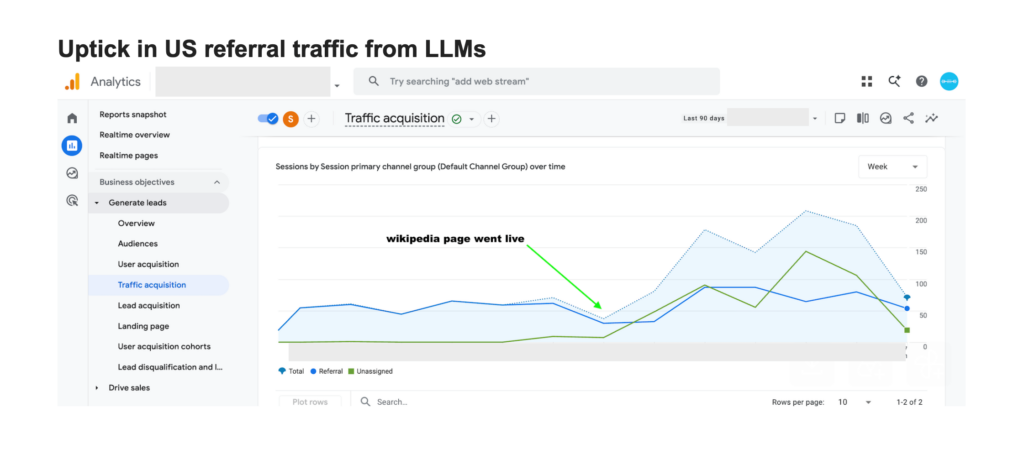
At Wiki Verification, we regularly hear from clients who see increased organic search visibility and AI-referred traffic after publishing a Wikipedia article about their company. Results vary, and this type of example should not be interpreted as proof of causation with 100% certainty. Still, the screenshot is a real client-side example of a pattern we often see: once a credible Wikipedia article goes live, referral activity can increase in ways that marketers typically associate with stronger authority and visibility.
That impact is rarely confined to a single metric. For brands already active in search and AI discovery, a Wikipedia article may coincide with a broader set of visibility signals, including stronger brand recognition, improved indexing, more branded searches, and additional citations or referrals from systems that rely on entity-level trust.
SEO benefits
The same authority signals that support AI visibility can also strengthen traditional search performance. First, a Wikipedia article can reinforce the brand entity itself. Search engines increasingly organize results around entities, including through systems such as Google’s Knowledge Graph. A clearly documented Wikipedia page can help confirm that the brand exists as a distinct, recognized subject.
Second, Wikipedia usually sits near the top of branded search results. That gives the brand another highly visible result page that searchers may encounter. Even when users do not click through, the presence of a Wikipedia page can improve perceived legitimacy as a public reference point outside the brand’s own site.
Third, Wikipedia can support broader citation patterns. When journalists, bloggers, researchers, and analysts need a quick reference for a brand, a Wikipedia article can often become a starting point. That can lead to more consistent naming, more accurate descriptions, and more secondary coverage, reinforcing entity recognition and indirectly supporting SEO.
Bottom line
If your brand has the independent coverage needed to support a Wikipedia article, that article can become an authority asset that helps search engines and answer engines understand who you are. When the article is live and the brand’s broader footprint is consistent, it can support the discoverability layer that modern SEO and AEO depend on.
Need to create or improve your Wikipedia presence? Review our Wikipedia page creation and editing services.